
Most packaging sustainability copy is adjectives. Ours is arithmetic: what goes into the drum, what comes back out of the plant, how much water the process uses, and how many empties fit on a truck. Here are the numbers, and where each one comes from.
We publish sustainability the same way we publish purity claims — with the mechanism named, so you can judge it rather than take it on faith.
Every drum we make is built from high-density polyethylene — resin identification code 2, one of the most widely accepted plastics in recycling streams.
Why it matters:the tri-layer wall is HDPE throughout, not a laminate of dissimilar materials. At end of service the drum body doesn’t need separation to enter a recycling stream.
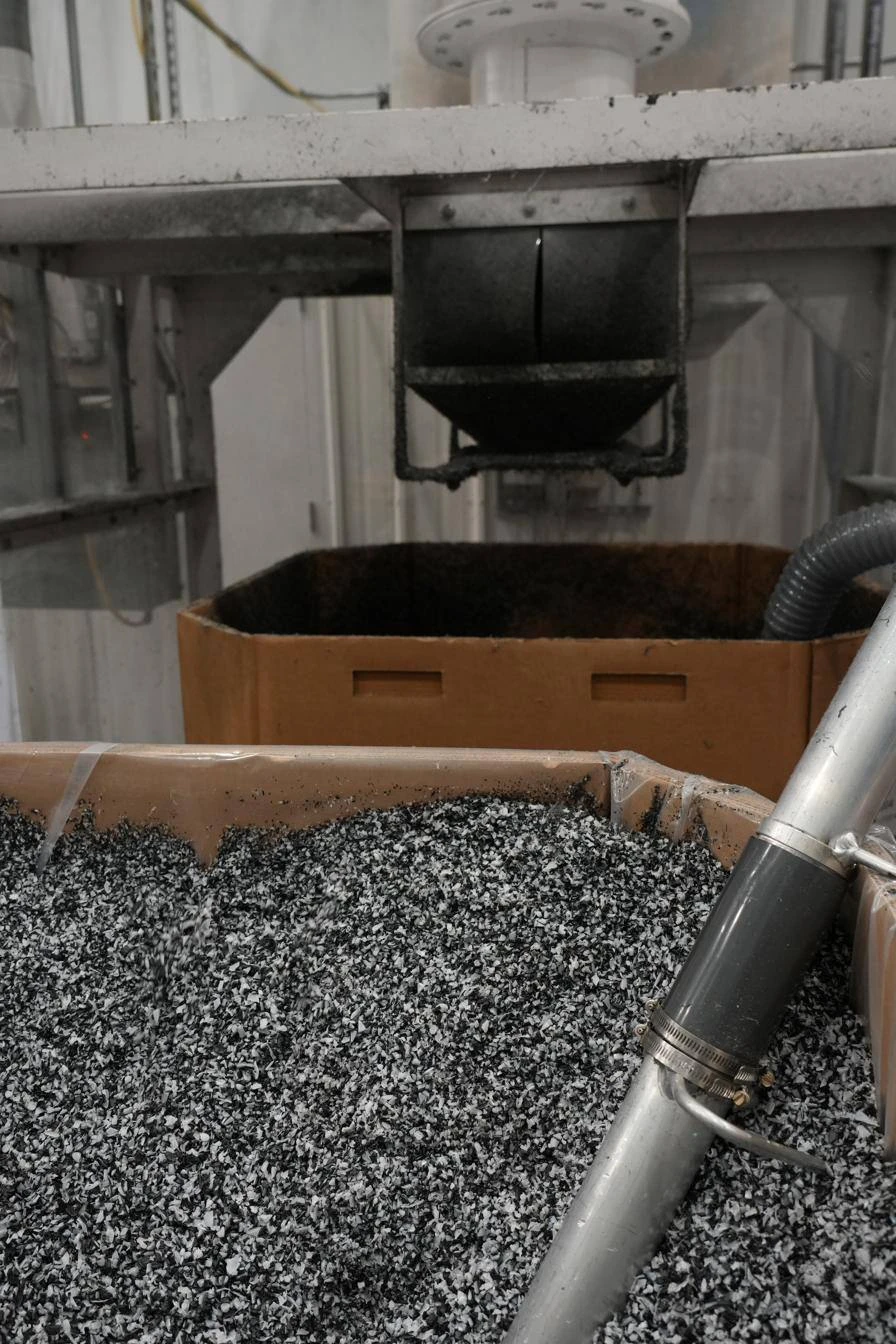
Production scrap, flash, and trim are reground and returned into the manufacturing process rather than discarded. Regrind is used in the middle layer only — the product-contact inner liner is always virgin HDPE. More than 99.5 percent of plant waste stays out of landfill.
Why it matters:diversion at this level isn’t a recycling program bolted onto the plant — it’s a consequence of how the molding process is run.
Our Maumee plant operates without process water in drum manufacturing — no process water consumed, and no process wastewater discharged from production.
Why it matters:for buyers reporting supplier water intensity, a zero-process-water plant is a number you can put in a supply-chain disclosure without a footnote.
The N55 is designed for multiple reuse cycles rather than single-trip disposal, and its conical shape nests empty drums so 728 fit in a 53-ft trailer.
Why it matters:the biggest environmental lever in drum packaging usually isn’t the drum — it’s how many trucks move empty volume on return lanes.
The landfill number isn't an offset or a purchase — it's the shape of the process itself.
HDPE arrives by rail directly to the plant, reducing truck movements per pound of resin delivered.
Tri-layer drums are blow-molded on automated lines. Flash and trim are generated at the mold — and captured immediately.
Captured material is reground and returned into manufacturing as middle-layer material only. The product-contact inner liner is always virgin HDPE.
Drums are recyclable HDPE, and the N55 system is built to be reused across cycles before that point ever arrives.
Answers to the questions we hear most before a first quote. If yours isn't here, the form is the fastest route to a specific answer.
Yes. Our drums are built from recyclable HDPE across the lineup. HDPE is resin identification code 2, one of the most widely accepted plastics in recycling streams, and the tri-layer wall is HDPE throughout — so the drum body doesn't require separation of dissimilar materials at end of service.
Less than half a percent. Production scrap, flash, and trim are reground and returned into the manufacturing process rather than discarded, which keeps more than 99.5 percent of plant waste out of landfill. Regrind is used only in the middle layer of the drum wall — the product-contact inner liner is always virgin HDPE.
Our Maumee plant operates as a zero-water manufacturing facility: the drum manufacturing process consumes no process water, so there is no process wastewater discharge from production.
Two ways. The N55 is designed for multiple reuse cycles rather than single-trip disposal, and its conical shape nests empty drums so approximately 728 fit in a 53-ft trailer — meaning fewer trucks moving empty volume on return lanes.
Yes — send it over. We'll complete what we can document and tell you plainly where we can't, which is the same standard we apply to purity and certification claims.
Whether it's a supplier questionnaire, a lifecycle comparison against steel or single-trip packaging, or a return-freight model for the N55 system — our team will work the numbers with you.